
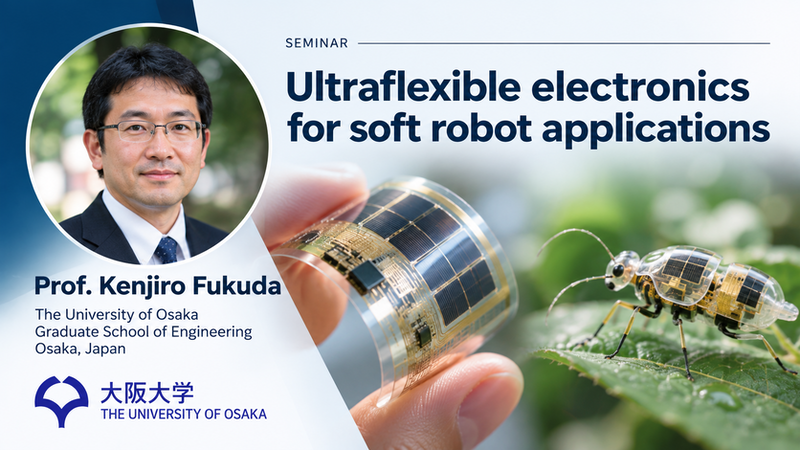
Seminario Prof. Kenjiro Fukuda
Title: Ultraflexible electronics for soft robot applications
Prof. Kenjiro Fukuda, The University of Osaka, Graduate School of Engineering, 2-1 Yamadaoka, Suita, Osaka, 565-0871, Japan.
Abstract: Soft robotics and bio-hybrid systems, such as cyborg insects, demand electronic components and energy sources that seamlessly integrate with soft, moving bodies without impairing mechanical mobility. Ultrathin and ultraflexible electronics̶particularly photovoltaics and sensors fabricated on micro-meter-thick polymer substrates̶offer superior power-per- weight ratios, extreme mechanical conformability, and high durability against repetitive deformation. In this seminar, I will present our recent advancements in ultraflexible organic electronics and their mechanical integration for autonomous soft robotic systems. We discuss key device design strategies that achieve high power conversion efficiency while ensuring environmental and mechanical stability. Furthermore, addressing the mechanical interface between soft actuators/biological tissues and electronic modules is crucial. Integrated with wireless control units and energy storage, these body-mounted ultraflexible devices realize continuous, self-powered wireless locomotion. Finally, I will discuss future engineering challenges and opportunities in mechanical design, material interfaces, and power systems for next-generation soft robotics.
Biography: Kenjiro Fukuda has been a professor at the Graduate School of Engineering, the University of Osaka, since April 2025. He received his Ph.D. from the Department of Applied Physics at the University of Tokyo in 2011. From 2011 to 2015, he worked at Yamagata University as an assistant professor. From 2015 until March 2025, he worked at RIKEN, first as a research scientist (2015-2018) and then as a senior research scientist (2018-2025), in the Thin-Film Device Laboratory and the Emergent Soft System Research Team at the Center for Emergent Matter Science. His current research interests include flexible solar cells, organic photovoltaics, flexible electronics, and printed electronics.