
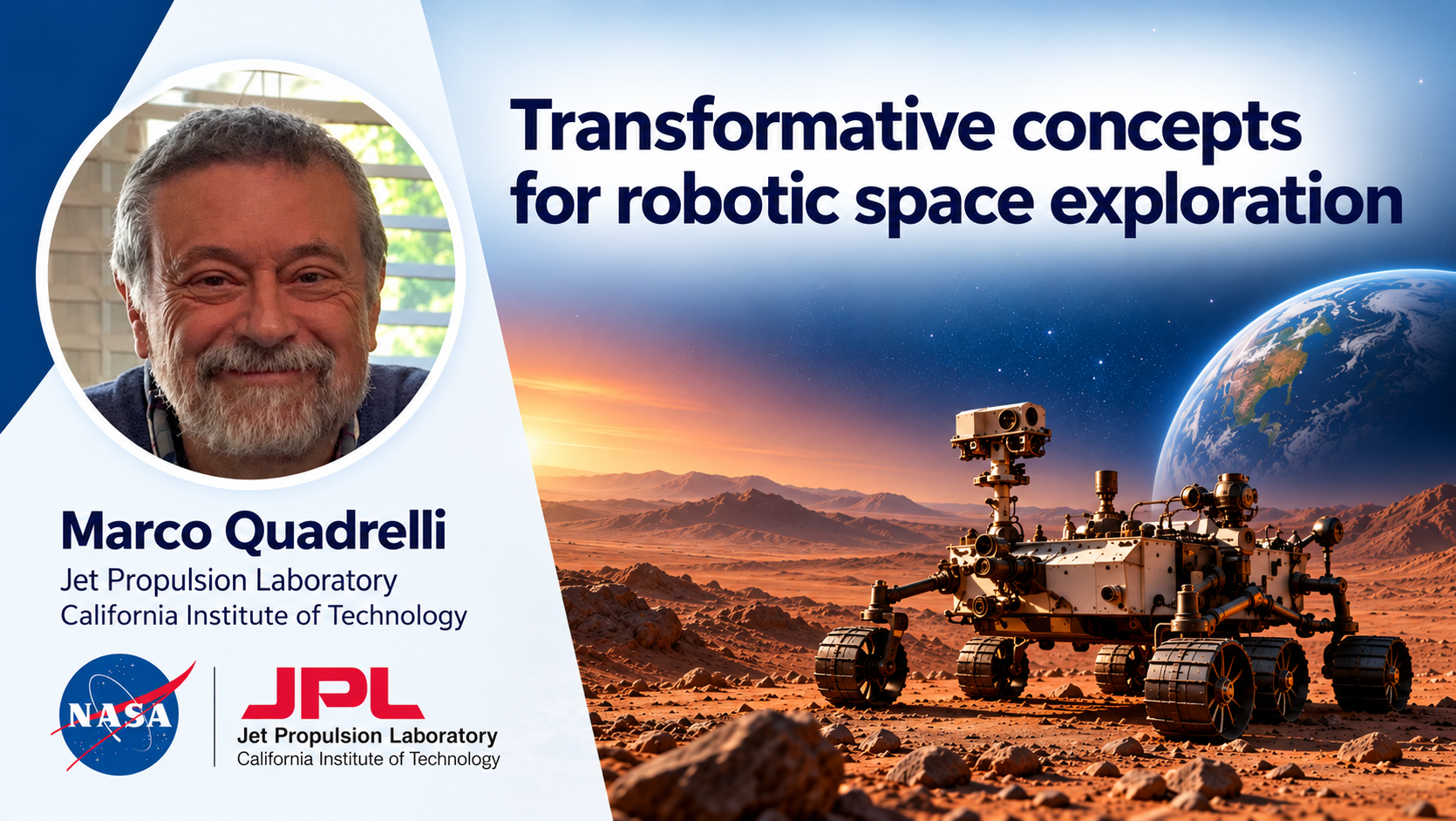
Seminario Dr. Marco Quadrelli
Transformative concepts for robotic space exploration
Dr. Marco Quadrelli, Jet Propulsion Laboratory (CA, USA)
Abstract: In this talk, Dr. Quadrelli will cover his experience with transformative concepts at JPL. He will cover a few categories of systems for space exploration characterized by the M4 paradigm (Multibody, Multi-physics, Multi-Domain, Multi-scale), addressing: a) Systems for Small Body exploration, which adapt to unknown extreme environments; b) Active phase-transition manipulation; c) Next generation Tlight systems with robust and precise aero-maneuvering; d) Unconventional systems and holistic out-of-the-box ideas to enable high-quality science; e) Quantum Robotics, exploring the intersection between quantum technologies and robotic systems. To keep pushing the boundary of the state-of-the-art in these exciting areas of application, the challenge of complexity and high level of uncertainty requires a signiTicant transformative approach to integrate developments in physics-based modeling and simulation, autonomy, GN&C, machine learning, vehicle design, system testing, uncertainty quantiTication, and many others.
Marco Quadrelli Dr. Quadrelli has been at JPL for almost 30 years, where he is a Principal Member of the Technical Staff in the Robotic Section at JPL. Previously, he was supervisor of the Robotics Modeling and Simulation group, and a Senior Analyst in the Guidance and Control Section. He has a degree in Mechanical Engineering from Padova (Italy), an M.S. in Aeronautics and Astronautics from MIT, and a PhD in Aerospace Engineering from Georgia Tech. He has worked in the aerospace industry, has been a visiting scientist at the Harvard-Smithsonian Center for Astrophysics and at the Institute of Paper Science and Technology in Atlanta, and a Lecturer at Caltech. He has contributed to a number of NASA Tlight projects including the Cassini-Huygens Probe, Deep Space One, the Mars Aerobot Test Program, the Mars Exploration Rovers, the Space Interferometry Mission, the Autonomous Rendezvous Experiment, and the Mars Science Laboratory, among others. He has been the Attitude Control lead of the Jupiter Icy Moons Orbiter Project, and the Integrated Modeling Task Manager for the Laser Interferometer Space Antenna. He has initiated and led numerous advanced research and technology development projects in multiple and diverse areas that include: complex distributed robotic systems on multiple environments, innovative telescopes for astrophysics, liquid crystal technology for imaging, modeling of multifunctional systems, distributed space systems, multibody system dynamics and control, integrated modeling of space observatories, tethered spacecraft, Entry Descent and Landing modeling and simulation, as well as granular media applications, biomedical systems, and quantum technologies. He is an Associate Fellow of AIAA (American Institute of Aeronautics and Astronautics), a Tive-time NIAC (NASA Innovative Advanced Concepts Fellow), and a Keck Institute for Space Studies Fellow.